
Book your private transfer!
Send us your transfer details and we will make you an offer.
When you step into a warm, clean and quiet vehicle for your private transfer in Lapland, you see the finished result.
What you don’t see is everything that happens before the journey begins.
Lapland’s winter is beautiful, but it is demanding — not only for drivers, but also for the vehicles they rely on. Temperatures can drop well below -30°C, roads can be covered in snow and ice, and during a busy winter season our vehicles can cover tens of thousands of kilometres.
For us, reliability is not something we can take for granted.
It starts long before a passenger gets into the vehicle.
A vehicle operating in Lapland during winter has to cope with conditions that are very different from normal everyday driving.
Extreme cold affects batteries, fluids, seals and electronics. Snow and ice put greater demands on tyres and brakes. Frozen and uneven roads can be hard on suspension and chassis components.
And then there is the mileage.
During a busy winter season, one of our vehicles can cover around 70,000 kilometres.
That means winter preparation is not something we do once at the beginning of November. It is an ongoing part of operating our fleet throughout the season.
Strong Batteries and Maintenance Chargers
A reliable battery is essential in Arctic conditions.
Cold temperatures reduce battery performance, while our vehicles may be started many times during a long working day. Before and during the winter season, we pay close attention to battery condition.
When vehicles are parked for longer periods, we use smart maintenance chargers to keep the batteries in peak condition and ready for the next journey.
It may be a small detail, but in extreme cold, small details matter.
Webasto Heating
Auxiliary heating is another important part of winter operation.
Our vehicles are equipped with Webasto heating systems, which help pre-heat the vehicle and keep the passenger cabin warm when temperatures are well below freezing.
For passengers, this simply means stepping into a warm vehicle.
For us, it is an important part of preparing the vehicle for the day.
Studded Winter Tyres: Grip Comes First
One of the most important decisions for winter driving is also one of the simplest: good tyres.
We use high-quality studded winter tyres designed specifically for Arctic snow and ice.
Lapland’s roads can change quickly. A road that appears clear can become icy, especially when temperatures fluctuate or moisture freezes on the surface.
Good tyres cannot eliminate winter driving challenges, but they provide the grip needed to deal with them safely.
For us, this is not an area where we want to compromise.
High-Performance Auxiliary Lighting
Lapland’s winter means long hours of driving in darkness.
Outside the towns, there may be very little ambient light, and during the darkest part of winter, daylight can be limited even during daytime hours.
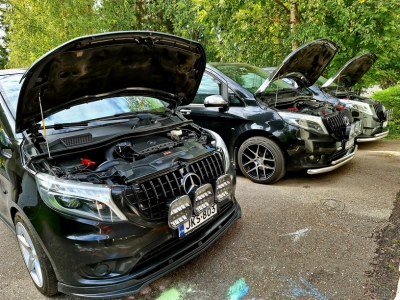
Our vehicles are equipped with high-performance auxiliary driving lights to improve visibility on dark roads and help our drivers see further ahead.
This is particularly valuable on long-distance routes through rural areas, where roads can be completely dark and wildlife such as reindeer may appear unexpectedly.
Good lighting does not replace careful driving, but it gives the driver more information about what is ahead — and in Arctic conditions, good visibility matters.
Snow and ice are not the only challenges.
Winter roads can be uneven, with frozen ruts, potholes and rough, ice-covered surfaces. When a vehicle is covering thousands of kilometres, this puts considerable stress on the suspension and underside of the vehicle.
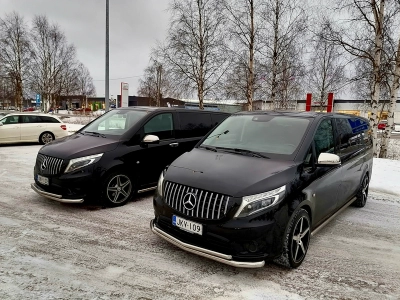
Our vehicles are equipped with steel underbody protection to help protect vital components underneath the vehicle.
It is one of those things passengers will never notice — and that is exactly the point.
Good preparation is often about protecting against problems before they happen.
Our routes regularly take us far beyond Rovaniemi.
Journeys to destinations such as Levi, Ylläs, Saariselkä, Ruka, Ivalo and Inari can involve several hours on the road.
During winter, many of these kilometres are driven in darkness, sometimes in heavy snowfall or on snow- and ice-covered roads.
That is why reliability becomes particularly important when travelling long distances.
A small technical problem in the city is one thing.
A problem hundreds of kilometres into an Arctic journey is something completely different.
Winter preparation does not end when the season starts.
Throughout the winter, our vehicles are regularly checked, cleaned and maintained.
We pay attention to the things that experience has taught us to watch:
Tyres and tread condition
Brakes
Batteries and charging
Heating systems
Lights and visibility
Suspension and chassis
Fluids and engine systems
Snow, moisture and road salt around the vehicle
The goal is simple: identify small problems before they become big ones.
There is also another side of winter preparation that passengers notice immediately.
Cleanliness.
Snow, water and road salt are part of everyday life in Lapland during winter. Passengers naturally bring snow and moisture into the vehicle after spending time outdoors.
We use durable rubber floor mats and clean the vehicles regularly to keep the interiors dry and comfortable.
Whenever possible, vehicles are cleaned and thawed in heated facilities. This also helps prevent ice from building up around doors, seals and other components.
After a long flight or several hours outdoors in Arctic conditions, getting into a warm, clean vehicle makes a difference.
Our fleet is built around Mercedes-Benz passenger vans, including the Vito and Sprinter.
The reason is not simply the badge.
For our operation, the vehicles need to combine several things that matter in Lapland:
Reliability for long-distance winter driving
Comfort for journeys that can last several hours
Practicality for families, luggage and small groups
Stability when road conditions change
We spend a lot of time on the road ourselves, so we know how important these qualities are during a long Arctic winter.
Of course, the vehicle is only one part of the equation.
Good winter tyres, heating systems, auxiliary lighting and modern safety technology are important, but they do not replace an experienced driver.
Lapland winter driving means understanding how quickly conditions can change, adjusting speed to visibility and road conditions, and knowing when a journey simply needs more time.
On remote roads, you also need to be prepared for the unexpected — including reindeer appearing on the road.
Experience matters.
When a passenger is picked up at Rovaniemi Airport or another location, puts their luggage in the vehicle and settles into a warm cabin, the journey should feel simple.
That effortless experience is the result we are aiming for.
Of course, no vehicle can be completely protected from unexpected faults or technical problems. Sometimes, things simply happen that are beyond anyone’s control.
What we can control is how well we prepare.
Through regular maintenance, inspections and careful winter preparation, we do everything we reasonably can to keep our vehicles in excellent condition and ready for your journey.
Behind that are winter tyres, batteries, maintenance chargers, Webasto heating, high-performance auxiliary lighting, steel underbody protection, regular inspections, cleaning and countless kilometres of experience on Arctic roads.
Some of the most important parts of a private transfer are the things passengers never have to think about.
That is what it takes to keep Lapland-Rides moving through the Arctic winter.

Send us your transfer details and we will make you an offer.